Does Revenue Come Before Investment or the Other Way Around?
31.08.2021
InsightsDoğukan Çetin
Assistant Fund Manager

If you search this question on Google, you will come across thousands of articles and comments defending both sides. Reading through them, you will notice that each argument has a certain logic.
The same dilemma appears in the start-up ecosystem, especially for ventures that have reached the Minimum Viable Product (MVP) stage. In this analogy, revenue represents the egg while investment takes the place of the chicken. For start-ups at the MVP level, there are typically three strategic paths to consider before launching a new funding round:
- Continue developing the product
- Increase market penetration
- Pursue proof of concept (POC)
Let’s take a closer look at these options.
The first path is generally preferred by start-ups developing complex software or hardware. These ventures often believe their MVP is not yet sufficient for market release and choose to delay launch to improve the product. Some teams believe in their MVP but still decide to allocate resources to further development in hopes of gaining an advantage with a more refined and feature-rich version.
Start-ups confident in their product and eager to test it in the market usually focus on increasing market penetration. This strategy involves acquiring as many users as possible in a short time through aggressive campaigns. B2C start-ups often implement tactics like free trials, discounted annual subscriptions, freemium memberships, and advertising. However, two questions must be considered: How many free users will convert to paying customers, and how does supporting free users affect the company’s budget?
B2B start-ups, on the other hand, usually target potential clients that can offer long-term value, serve as future references, and help boost visibility. Founders with strong networks gain an important edge when expanding into the B2B space.
The third option is monetizing the MVP. Start-ups that choose this route do not need a perfect product to begin generating income. With meaningful partnerships, they can launch and improve their product simultaneously. The key to success in this model is transparency. Users or partner companies must be clearly informed that the product is still under development. Data generated from these partnerships should be accessible to the start-up to improve the product. Feedback loops must be established. However, excessive customization for a single client can distract the team from their core focus. This is why having a scalable business model is critical.
So which of these paths is most attractive to venture capital investors?
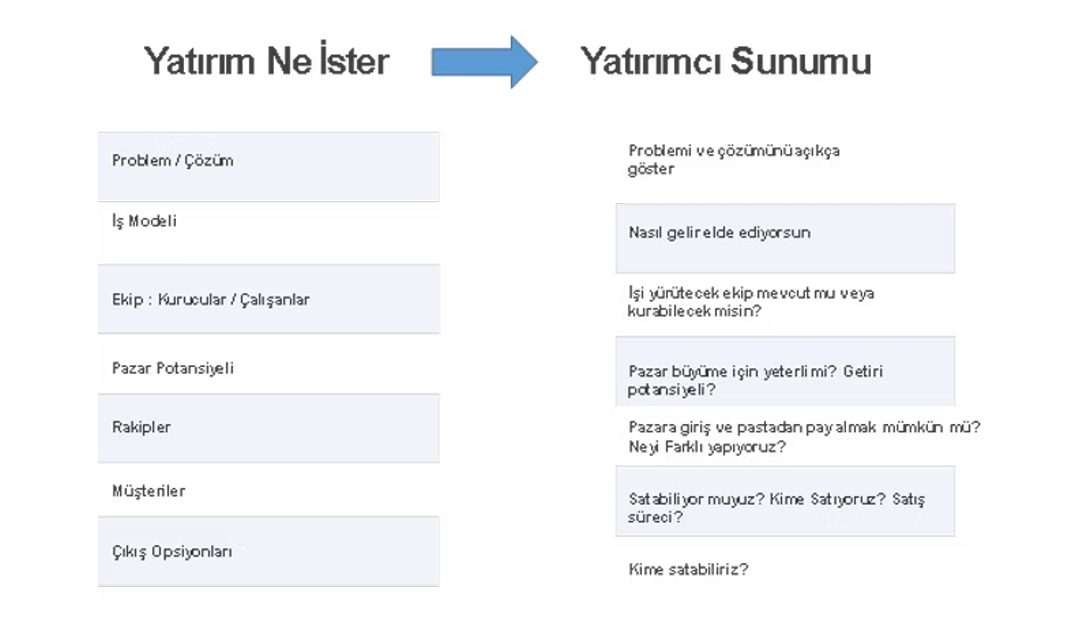
In general, investors prefer start-ups that have already started generating revenue. These start-ups have validated their business model with actual income, which reduces perceived risk. They are also more likely to grow quickly and justify higher valuations in future rounds.
This brings us back to the original question: Does investment come before revenue, or does revenue come before investment?
From an investor’s point of view, revenue comes first. Investment is viewed as a tool that accelerates a growth trajectory that has already been proven. Simply receiving funding does not guarantee revenue growth. If the start-up has already identified the right sales or growth channel, it can maintain momentum using its own resources for a while. This gives the team better insight into how to use future capital effectively and also provides compelling metrics during fundraising.
In short, when viewed from the investor’s side, the ability to make sales and prove customer demand is often more important than raising capital itself.
Sources:
- https://www.growthbusiness.co.uk/revenue-or-user-growth-what-should-come-first-for-tech-start-ups-2551836/
- https://www.linkedin.com/pulse/amount-revenue-your-startup-should-generate-before-looking-cohen/
- https://jproco.medium.com/choosing-revenue-streams-for-your-minimum-viable-product-99cc212f12d5
- https://marker.medium.com/how-startups-get-to-revenue-fast-3575332f2955