What Do Investors Look For in Start-ups?
12.10.2021
InsightsAPY Ventures
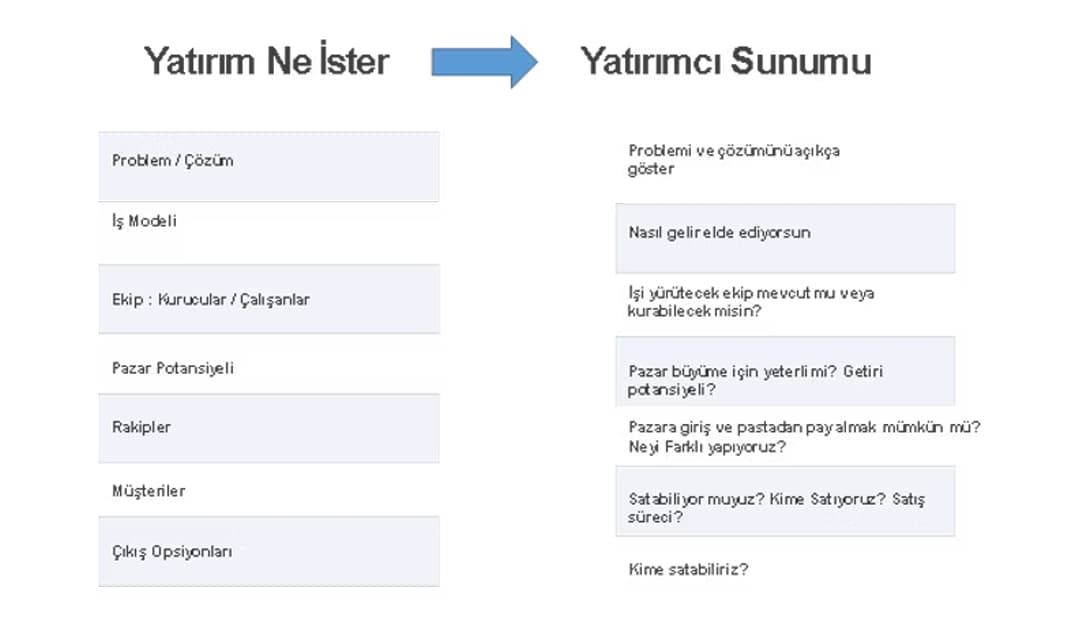
This is one of the most frequently asked questions by founders and also one of the most discussed topics online. Every investor has their own evaluation criteria and perspective shaped by their team’s strengths. Here, I will briefly summarize how APY Ventures approaches this question. This summary will also help clarify what we expect to see in a start-up pitch.
First of all, we need to be the right investor for the start-up we meet. If the sector in which the start-up operates is not within our area of interest, or if the stage of the start-up is too early or too late compared to our investment strategy, it falls outside our scope regardless of its potential. That is why it is important for founders to know who they are applying to.
If a start-up is within our scope, the first thing we focus on is the team. While we prefer to see multiple founders, we also evaluate start-ups with a solo founder. At an early stage, having several strong competencies is critical for revealing potential. In multi-founder start-ups, it is easier to handle multiple areas at once such as technical infrastructure, marketing, sales and customer support. If there is a single founder, the team they build gives us valuable clues about their ability to recruit and manage talent. The presence of a strong core team that can take the start-up from zero to one is a critical factor shaping the future of the company. What we expect from the founding team is a technically strong product, the ability to rapidly develop and adapt it according to market dynamics and customer feedback, the ability to reach the right market and audience, a vision to support fast growth, and the capacity to build a team that will sustain that growth. In addition to all of this, the passion of the founders for their product excites us deeply.
Once we identify a strong team, we ask whether their solution actually addresses a real problem. If we believe that it does, we then evaluate how large the potential market is and how fast we can reach it. Scalability is one of the most important factors in our investment decision. We look for start-ups that either have a highly scalable product or generate high customer value even if their sales cycles are slow. This brings us to the business model. We ask whether the founders’ business model can capture enough value, whether it can adapt to obstacles along the way, and how much friction it creates in the sales process. A high-friction model often becomes a major barrier regardless of the product’s potential.
At this point, we begin to assess market dynamics. Is it a sufficiently large market? What does the competition look like? What gives the start-up an edge? Having many competitors in the market is not a deal-breaker for us, but we expect the start-up to have a solid plan for market entry. In less competitive markets, we try to understand the current level of market penetration.
Once we are convinced about the market, we turn to the customer. A convincing market also validates the existence of demand, but we then ask whether the product is good enough to satisfy that demand. We expect founders to understand their target customer well. One of the most important signs of this is customer engagement and feedback. The team should be actively communicating with potential users and incorporating their feedback while shaping the product. If the start-up is beyond MVP stage, we then look at current sales performance and user responses more closely, since the product is now in the hands of real customers.
Finally, we come to the investor’s core concern: can we eventually exit the investment, and what will the return be? If we cannot find a satisfactory answer to this question, we begin to lose interest. Even if everything else is perfect, not being able to foresee an exit would mean we cannot fulfill our responsibility as investors.
In this post, I tried to briefly outline what we look for when making an investment decision. These are not absolute truths and investors certainly do not always get everything right. Still, I hope this perspective is helpful for founders preparing for a fundraising round.
At APY Ventures, we welcome all start-ups that share our mindset to apply to one of our active funds. You can always reach us via www.apyventures.com.